

Security made easy for every login
The password manager without a vault

Features you expect from a password manager

The real benefit comes from using it

The result: always strong, unique passwords.

Traditional password managers primarily help users manage passwords securely and often fill them in automatically. In doing so, they solve part of the password problem.
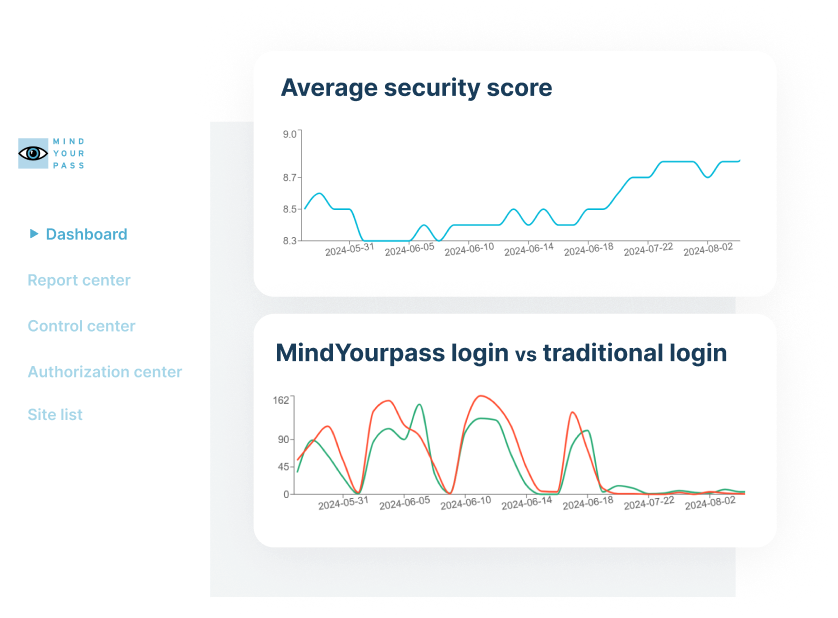
MindYourPass goes further. In addition to a powerful password manager, it provides organizations with continuous insight into applications, authentication methods, password usage, and login risks. Based on this, organizations can centrally apply and enforce security policies, ensuring that secure login is not dependent on the behavior of individual users.
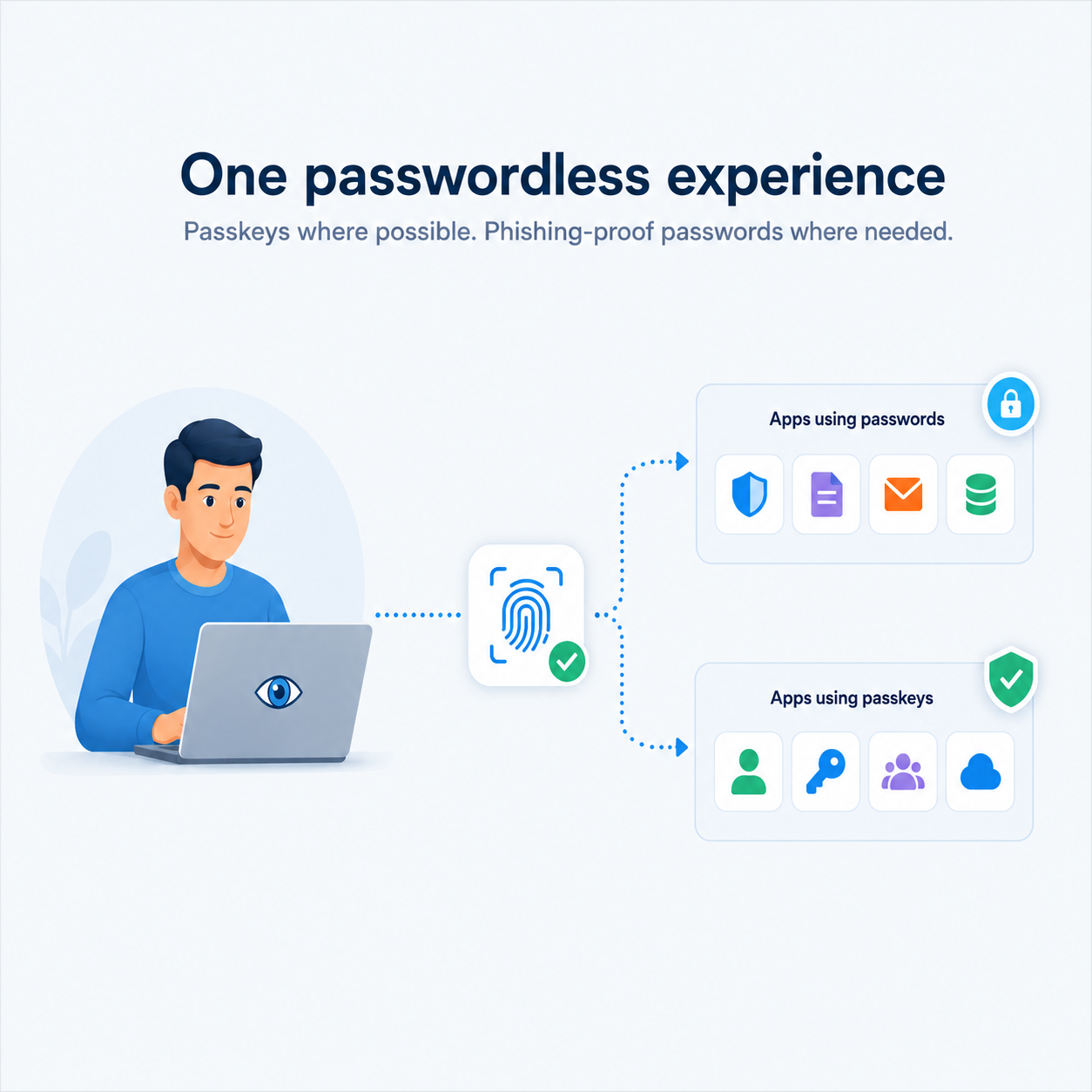
Furthermore, MindYourPass supports both passwords and passkeys from a single platform. Organizations gain insight into their passwordless readiness and can realize the transition to passkeys step-by-step, while applications that still rely on passwords remain securely supported.
MindYourPass also distinguishes itself through its patented vaultless technology, which ensures that passwords are not stored in a traditional password vault.
This is how MindYourPass helps organizations continuously improve digital access: from secure and phishing-resistant password usage today to a controlled transition to passwordless.
MindYourPass was developed for organizations that want to manage digital access in a secure, controllable, and future-proof way. The platform is suitable for small, medium, and large organizations alike and is used across sectors including government, healthcare, education, housing associations, accounting, and the corporate world.
Whether an organization wants to get started with secure password management, implement passkeys, comply with laws and regulations like NIS2, or gain better insight into applications and login risks: MindYourPass supports every stage of the journey toward secure digital access.
Thanks to its modular design, organizations can start by gaining insight through monitoring and then expand the platform with secure password management, passkeys, and centralized security policies.
MindYourPass's patented vaultless technology calculates a password every time it is needed. As a result, passwords never need to be stored in a central or local password vault.
For every site or web application, the exact same password is calculated based on a set of unique data. Because the same input always leads to the same result, the password can be regenerated on any authorized device without ever needing to be stored.
Furthermore, the calculation is domain-specific. This ensures that a unique password is automatically used for every web application, preventing a password from being used on another website or phishing domain.
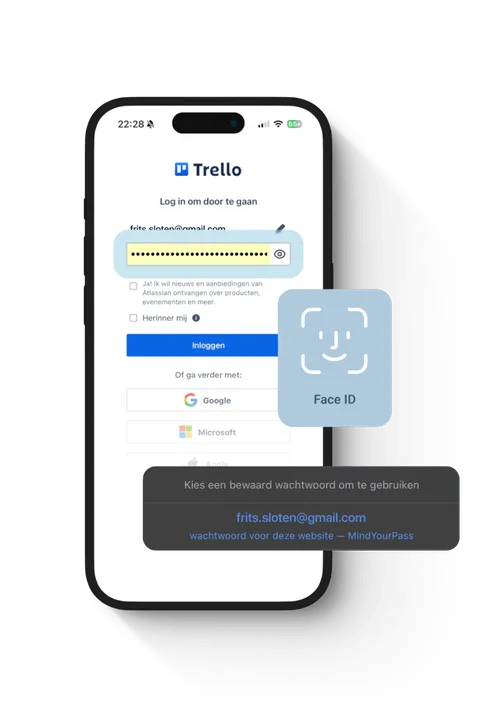
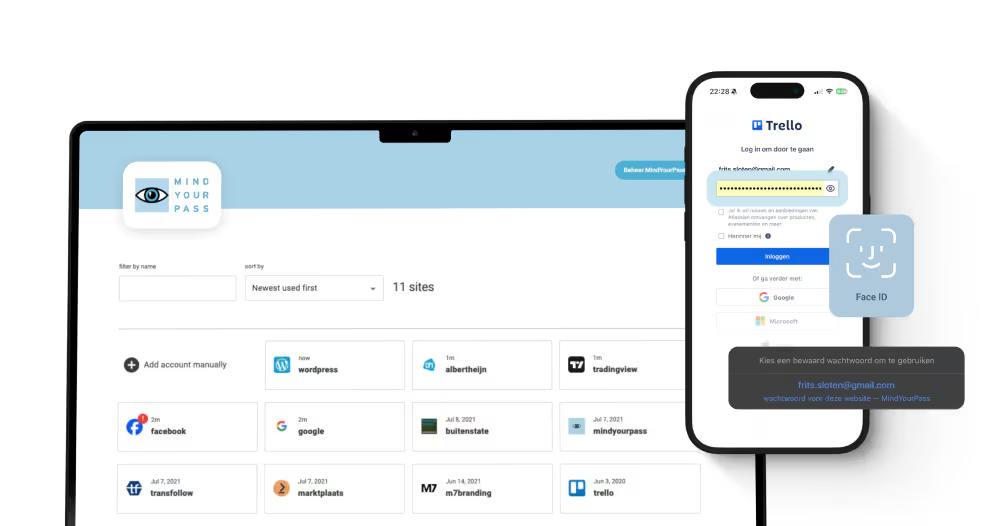
For the user, this works just like a traditional password manager: after verification, the correct login credentials are automatically filled in. Behind the scenes, however, passwords are calculated rather than stored.
MindYourPass helps organizations significantly reduce phishing risks during login.
When users log in with a passkey, authentication is inherently phishing-resistant.
For web applications that still use passwords, MindYourPass provides an additional layer of protection. Its patented vaultless technology generates a unique, domain-bound password for every website. This ensures that passwords cannot be interchanged between sites, meaning a password intended for one website cannot be used on another.
In addition, the MindYourPass Password Manager only auto-fills login credentials on the correct website. This eliminates the need for users to manually enter or copy and paste passwords, further reducing the risk of successful phishing.
In this way, MindYourPass offers a single, secure login experience for both password-based and passwordless applications.
The implementation of MindYourPass always begins with a technical setup.
For a MindYourPass Assessment or Monitoring, the implementation consists of the technical installation of the MindYourPass Agent.
Implementing the MindYourPass Password Manager involves both a technical software setup and an organizational rollout. In addition to the technical configuration, this includes a focus on user deployment, communication, onboarding, training, and user adoption.
Separate implementation guides are available for each solution, describing the implementation steps in detail.
Yes. MindYourPass integrates with existing Single Sign-On (SSO) solutions, such as Microsoft Entra ID, Okta, and other Identity Providers that support SAML or OpenID Connect.
Web applications that already support SSO continue to use the existing Identity Provider directly. MindYourPass does not take over this authentication and does not change the existing SSO login flow.
Users sign in to MindYourPass using SSO via the organization's Identity Provider. From there, they can also securely log in to web applications that are not linked to SSO and still require a password. For the user, this feels like the same simple login experience as SSO, for example using Windows Hello, biometric verification, or a FIDO2 security key, without them ever having to enter passwords again.
This creates a single, consistent login experience for all web applications, regardless of whether they use SSO, passkeys, or passwords. MindYourPass calls this Total Sign-On: extending the benefits of Single Sign-On to web applications that do not yet support SSO.
This offers similar benefits for organizations as well. Access to the MindYourPass Password Manager can be managed centrally via the Identity Provider. As a result, existing security measures, such as user provisioning, deprovisioning, and conditional access, can also be applied to access for web applications that still rely on passwords.
Password Manager 2.0
With our three-step approach — Identify - Improve - Insist — you tackle the problem at the core. Structural and effective.
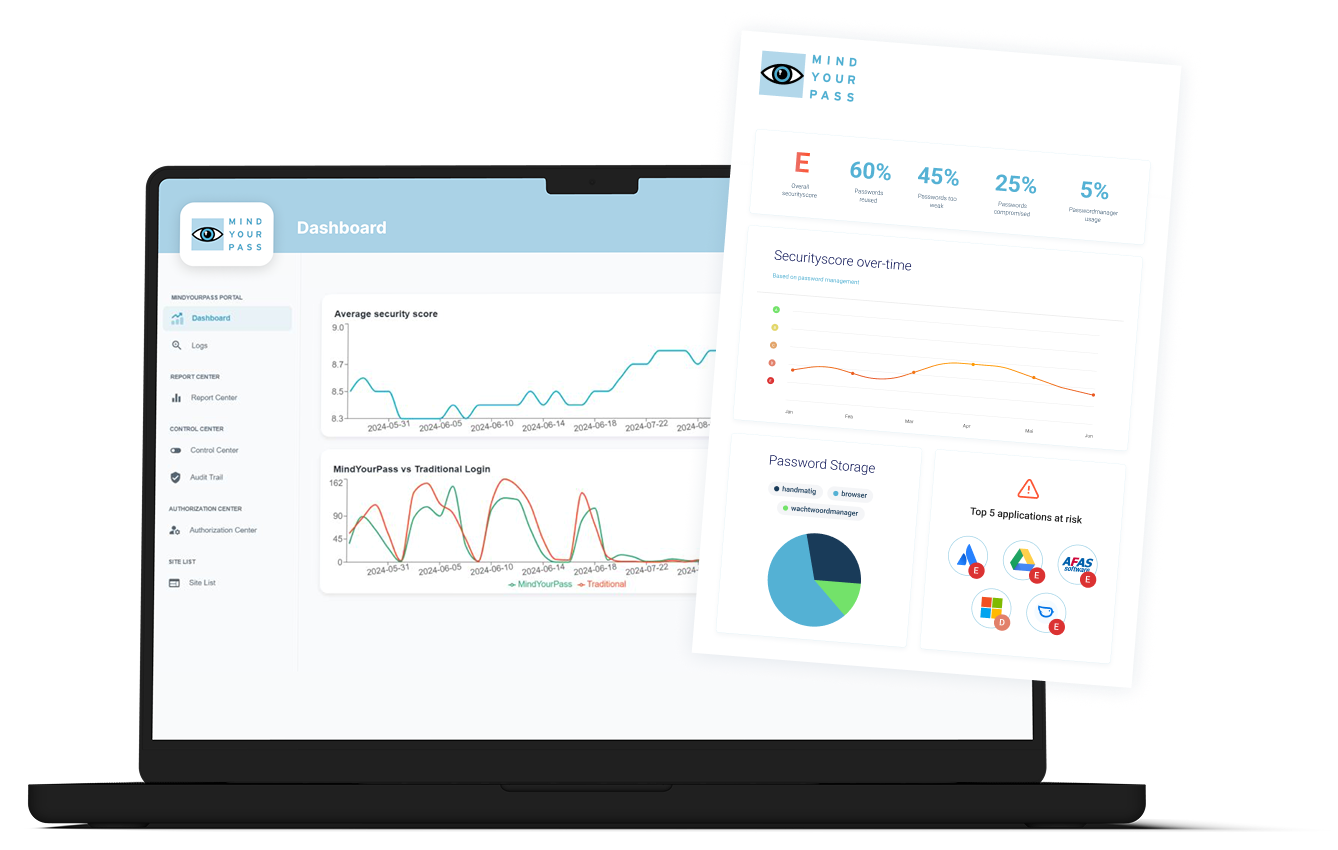
See how secure your logins really are
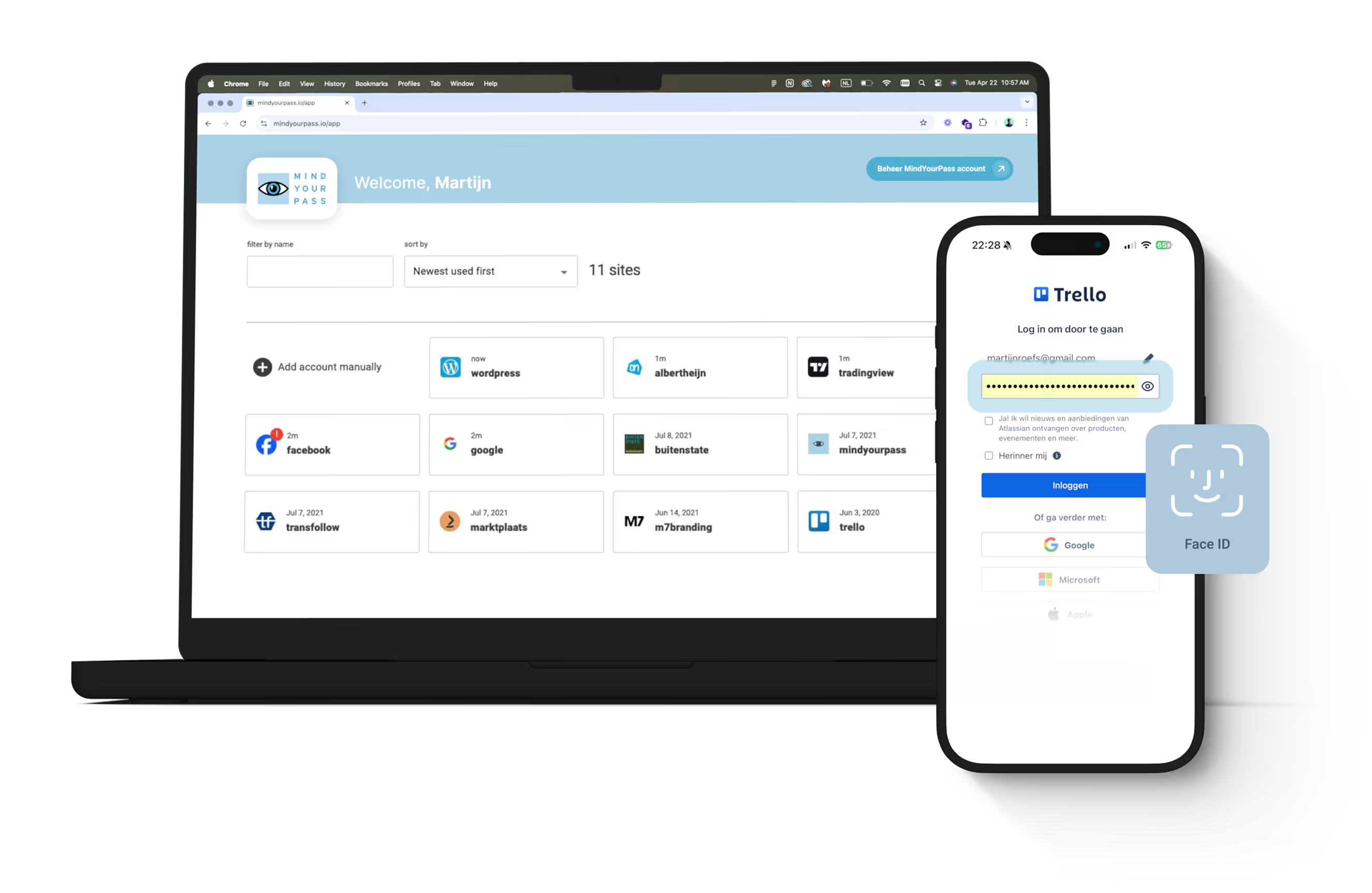
A password manager people really use
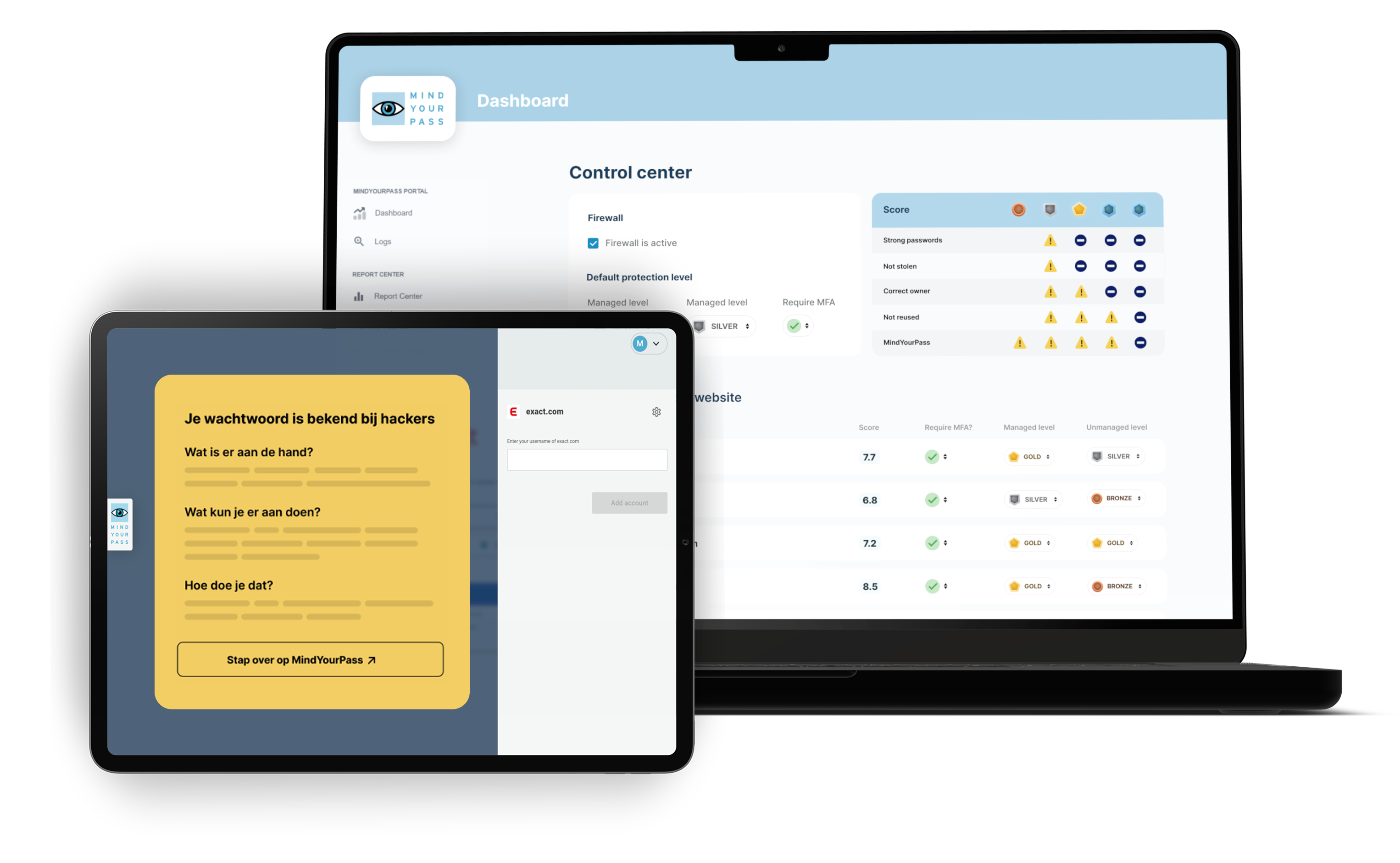
From paper policy to enforcement in practice
Logging in securely requires more than just a tool

Everything you need to log in securely
Comprehensive online how-to academy with tutorials and instructions for end users and administrators
Prevent password phishing by smartly recognizing fraudulent login pages
Let MindYourPass manage your passkeys cross-platform
Protect any business application with an extra layer of security, even those that don't have MFA themselves
Keep business and private passwords strictly separate. Free for private use
Securely share access to shared accounts with authorized people without sharing the password
Simply log in with facial recognition or a fingerprint without manually entering your password
Stop storing passwords in a hackable vault. MindYourPass's patented technology is safe, but reproduces passwords when you log in.
Generate rock-solid and unique passwords and easily set them for any account with one click.
Privacy guaranteed — always
Depending on the situation, you may encounter three different types of passwords or authentication methods.
Master password or SSO password
Use this to sign in to your MindYourPass account.
- Private users use a master password.
- Business users usually sign in via Single Sign-On (SSO), for example using their Microsoft 365, Google, or other organizational account.
Easy-to-remember password
The easy-to-remember password is the standard MindYourPass user authentication method. It is part of the generation process that MindYourPass uses to calculate account passwords.
Instead of an easy-to-remember password, you can also choose biometric authentication or a QR code.
Account passwords
Account passwords are the unique passwords you use to sign in to your web applications.
By default, MindYourPass automatically creates and calculates a unique, strong account password of up to 128 characters for every web application. You do not need to remember or manually enter these passwords.
Would you like to (temporarily) continue using your existing passwords? You can choose traditional passwords. MindYourPass will then use your existing account passwords until you choose to replace them with automatically calculated account passwords.
Please note: the master password (of SSO password) is used exclusively to log in to your MindYourPass account. The easy-to-remember password is used for user authentication before MindYourPass calculates an account password or uses a passkey.
No.
The easy-to-remember password is just one of the components MindYourPass uses to calculate the password for one of your accounts.
Each calculation also requires your personal MindYourPass account, the relevant web application, and several cryptographic components of MindYourPass. These components are not known to users and cannot be easily discovered by third parties.
Furthermore, the easy-to-remember password is not used as the password for your web applications and is not stored as such.
As a result, someone who only knows your easy-to-remember password cannot simply calculate or use your passwords.
The easy-to-remember password is the standard user authentication method for MindYourPass. It is part of the generation process used by MindYourPass to calculate passwords.
Before MindYourPass calculates a password or uses a passkey, it first verifies that you are the authorized user. This aligns with the Zero Trust principle: a user is not automatically trusted, but must verify their identity before access is granted.
Unlike the passwords for your web applications, the easy-to-remember password does not need to be unique or complex. In fact, you should choose a password that is easy for you to remember.
Because MindYourPass automatically calculates a unique and strong password for every web application, you no longer need to remember separate passwords for your web applications.
By default, the easy-to-remember password is used for user authentication. You can also choose to use biometric authentication or a QR code.
MindYourPass operates according to the Zero Trust principle: a user is not automatically trusted. Before a password is calculated or a passkey is used, MindYourPass therefore requires user verification. This confirms that the authorized user is performing the action.
Depending on your preference, you can verify yourself using:
- a memorable password (default);
- biometric verification (FIDO2), such as a fingerprint or facial recognition and FIDO2 keys;
- a QR code with the MindYourPass app.
The chosen verification method is part of the generation process and is separate from logging into your MindYourPass account.
More information about the memorable password can be found in the relevant FAQ.
Yes. Anyone can use the MindYourPass Password Manager for free to manage personal passwords and other private data.
Users with a MindYourPass business account can easily use a personal environment alongside their business environment. Business and personal data remain logically separated, ensuring both user privacy and organizational control.
The personal environment is fully owned by the user and will always remain free to use, even if the business account ends, for example when leaving a job or switching to a different employer. Personal passwords, passkeys, secure notes, and other private data are retained and remain accessible. A paid personal subscription is not required for this.
This allows users to use the same trusted password manager for both work and personal life, without being dependent on their employer and without the risk of losing personal data when leaving the company.